
Noise at Work Surveys: Expert Workplace Noise Assessments in the UK
We are specialists in noise at work surveys and workplace noise assessments. We help UK businesses identify and manage noise exposure risks, ensuring compliance with regulations through accurate noise surveys. Our services include detailed measurements, risk evaluations, and recommendations for hearing protection and audiometry, tailored for industries like manufacturing, construction, and engineering.
What is a Noise at Work Survey?
A noise at work survey, also known as a workplace noise assessment or noise exposure assessment, is a professional evaluation of sound levels in your work environment. Using advanced equipment, we measure daily and peak noise exposures to determine if they pose risks to workers' hearing.
These surveys are crucial for detecting hazardous noise sources, such as machinery or tools, and providing data to implement controls. By conducting regular noise at work surveys, employers can prevent noise-induced hearing loss, tinnitus, and other health issues while meeting legal standards.


UK Legislation on Noise at Work
The Control of Noise at Work Regulations 2005 govern workplace noise management in the UK. Enforced by the Health and Safety Executive (HSE), these regulations, effective since April 2006 (and 2008 for music and entertainment sectors), require employers to protect workers from excessive noise that could cause irreversible hearing damage.
Key duties include conducting noise assessments if exposure is likely at or above specified levels, implementing control measures, and maintaining records. The HSE's guidance document L108, in its third edition updated August 2025, provides detailed advice on compliance, including practical noise control strategies.
Non-compliance can lead to fines, enforcement notices, or legal claims, making professional noise at work surveys essential for risk mitigation.
Noise Exposure Levels and Action Requirements
UK legislation defines specific noise exposure levels triggering actions:
- Lower Exposure Action Value (LEAV): 80 dB(A) daily or weekly personal noise exposure, or 135 dB(C) peak sound pressure. At this level, employers must assess risks, provide information and training, and offer optional hearing protection.
- Upper Exposure Action Value (UEAV): 85 dB(A) daily or weekly, or 137 dB(C) peak. Here, hearing protection becomes mandatory, hearing protection zones must be designated, and health surveillance (including audiometry) is required.
- Exposure Limit Value (ELV): 87 dB(A) daily or weekly, or 140 dB(C) peak. Workers must not be exposed above this, even accounting for hearing protection attenuation.
Our noise at work surveys accurately measure these levels using dosimetry and sound level meters, helping you identify if action is needed.

Benefits of Workplace Noise Assessments
Conducting noise at work surveys offers significant advantages:
- Risk Reduction: Pinpoints high-noise areas to implement engineering controls, like enclosures or silencers.
- Legal Compliance: Ensures adherence to the 2005 Regulations, avoiding HSE penalties.
- Worker Protection: Safeguards employee health, reducing absenteeism and compensation claims.
- Cost Efficiency: Prevents expensive retrofits by addressing issues early.
- Improved Productivity: A quieter workplace enhances focus and safety.
Regular workplace noise assessments demonstrate your commitment to a healthy work environment.
Our Noise at Work Survey Process
At [Your Company Name], we deliver thorough, minimally disruptive noise surveys:
- Site Visit and Planning: We consult on your operations and schedule assessments during typical work periods.
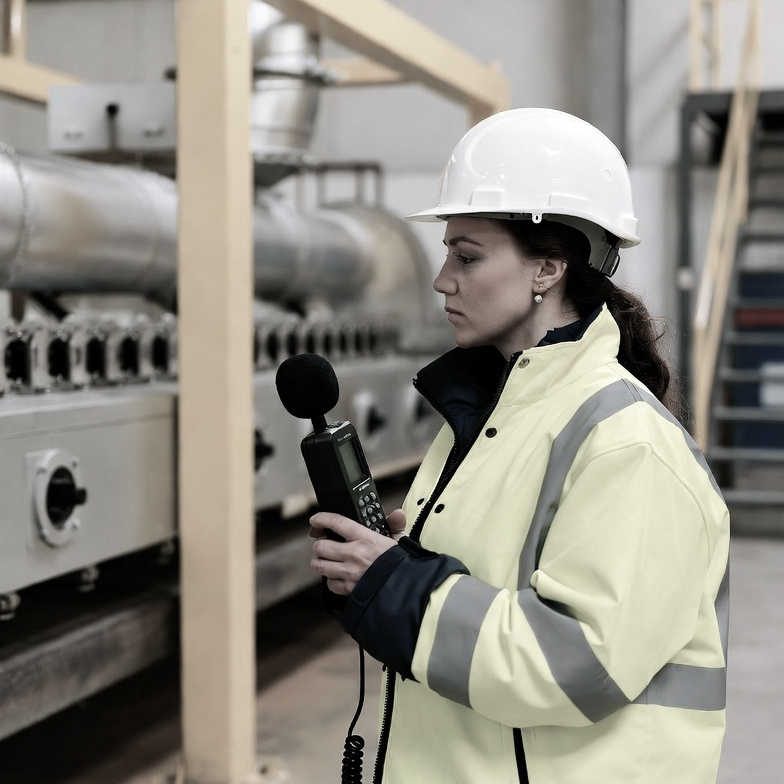
- Noise Measurements: Using calibrated equipment, we conduct spot checks, full-shift dosimetry, and peak level monitoring.
- Data Analysis: Evaluate exposures against regulatory thresholds.
- Recommendations: Suggest noise reduction strategies, hearing protection, and follow-up actions.
- Report Delivery: Provide a comprehensive report within days.
Our process aligns with HSE best practices for accurate workplace noise assessments.
Reporting and Documentation in Noise Surveys
Every noise at work survey includes our exemplary report writing service at no extra cost. Reports are detailed, compliant, and easy to understand, covering:
- Measured noise levels and exposure calculations.
- Risk assessments and compliance status.
- Action plans for noise control and hearing protection.
- Recommendations for health surveillance.
Under the regulations, employers must record assessments if they employ five or more workers, review them regularly (e.g., every two years or after changes), and keep records for at least two years. Our reports support audits and demonstrate due diligence to regulators.
Requirements for Hearing Protection and Audiometry
If noise exceeds the UEAV (85 dB(A)), employers must supply suitable hearing protection, such as earplugs or earmuffs, and ensure proper use through training. Protection must reduce exposure below the ELV (87 dB(A)).
We assess protection effectiveness during surveys, recommending selections based on noise frequency and worker needs. Maintenance and fit-testing are also advised to maintain efficacy.
Noise at work surveys often reveal the need for health surveillance. If exposures reach or exceed the UEAV (85 dB(A)), or if workers are vulnerable, employers must provide audiometry; regular hearing tests to monitor for early damage.

Why Choose National Audiometry Services for Noise at Work Surveys?
Backed by extensive experience in UK acoustic consultancy, National Audiometry Services has conducted countless workplace noise assessments for diverse sectors. Our certified experts deliver precise, actionable insights with included premium reports.
Contact us to book your noise at work survey and protect your workforce today.

Get in touch
Telephone: 01302 858874
E-mail: contact@nationalaudiometryservices.co.uk
Address: High Street, Wadworth, Doncaster, DN11 9BG